
What We Now Know About the Size and Needs of Black-Owned Businesses in Canada

When conversations about supporting Black entrepreneurs take place, they rarely begin with scale. But size matters, particularly when it determines what resources a business can access, how fast it can grow, and the likelihood of long-term survival.
A new national study by the Black Entrepreneurship Knowledge Hub (BEKH) offers one of the most detailed statistical portraits of Black-owned businesses in Canada to date. Based on responses from more than 2,300 Black entrepreneurs across the country, the report shows that these businesses reflect global diversity, with owners from over 60 countries. It also reveals that most Black-owned businesses are small by any standard, and that the smaller the business, the greater the barriers.
Breaking Down the Numbers
Under current federal definitions, any business earning under $2 million annually is considered “small.” That category includes a wide range of enterprises, from part-time sole proprietorships to firms with employees and established customer bases. Treating them the same conceals important differences in capacity and need. “Accurate definitions are essential to measure, plan, and sufficiently resource services,” said Dr Muna Osman, Senior Research Scientist at the BEKH. “Current definitions of startups, small, and medium size businesses do not include the nature and dynamics of the Black businesses we saw in the BEKH survey.”
To capture a more accurate picture of business size within the Black entrepreneurial ecosystem, BEKH introduced two additional categories, nano and micro, based on revenue.
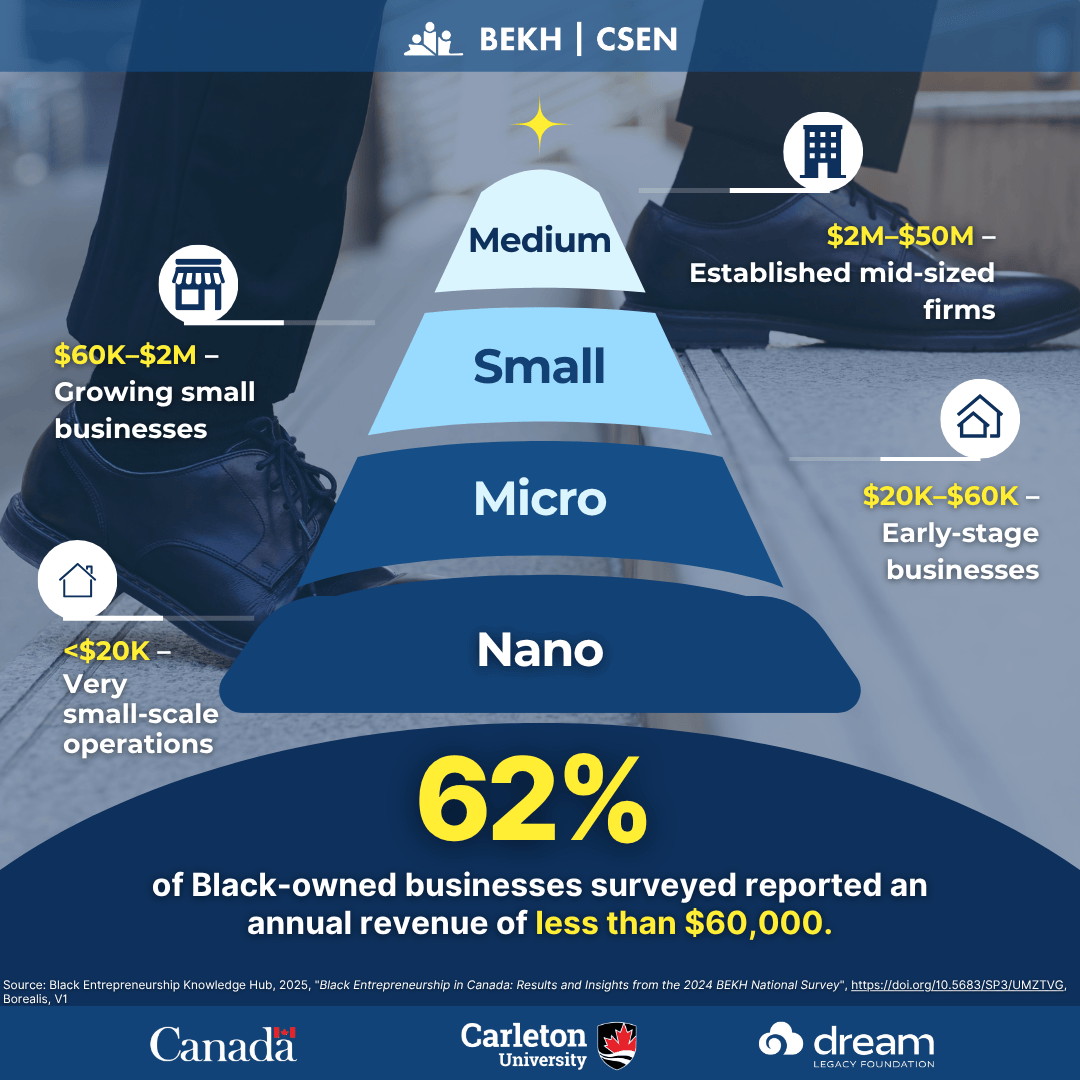
Source: Black Entrepreneurship Knowledge Hub, 2025, "Black Entrepreneurship in Canada: Results and Insights from the 2024 BEKH National Survey", https://doi.org/10.5683/SP3/UMZTVG, Borealis, V1
This made it possible to see where most Black-owned businesses sit on the revenue spectrum. The findings show a clear concentration in the nano and micro ranges. These are not failed businesses; they are under-resourced businesses. “We saw these entrepreneurs often continued to work alone and have stagnant revenues even many years after starting their businesses,” Dr. Osman explained. “They did not know where or how to access financing despite having advanced professional degrees. These conditions meant these businesses were not identified as typical startups, small, and medium size businesses. As such, they are not measured and adequately resourced.”
Access Tied to Revenue
The survey found that access to capital, business development services, and government programs was closely correlated with business size. Owners of nano and micro enterprises were far less likely to be aware of public funding opportunities or to have navigated formal lending systems. Many had never applied for external financing, either because they didn’t know what was available or because they assumed they wouldn’t qualify.
In contrast, businesses in the medium category were more likely to be incorporated federally, employ staff, and report stable growth. Their ability to scale was not solely due to business model or sectors. It reflected a different level of institutional access.
Two-thirds of Black entrepreneurs surveyed operate a single business, many without staff or external support. Yet the goals they articulated, such as financial independence, intergenerational wealth, and regional expansion, make it clear they are not content to remain at their current scale.
A Need for More Targeted Support
Public programs that rely on broad classifications can miss critical distinctions. A business earning $18,000 annually doesn’t face the same challenges or require the same tools as one generating millions. Yet without disaggregated data, policy responses often default to one-size-fits-all solutions. “Due to historical and ongoing disadvantages, many Black business owners are not able to start, sustain, scale, or grow their businesses without tailored programs and services,” stressed Dr Osman.
The findings in this report highlight the value of more precise, scale-aware approaches that consider where a business is in its growth, not just what sector it’s in or where it’s located. That includes financing models, outreach strategies, and advisory services that are designed to be usable by businesses at every stage. As Dr. Osman emphasized, “Evidence-based definitions of businesses, based on Black entrepreneurs’ own words, will be essential to tailor strategies and drive business growth and success for Black entrepreneurs.”
As governments and institutions look to better support entrepreneurship, this kind of targeted approach becomes even more critical. To see increased economic growth in the long-term, Canada’s goal should be more than just serving established enterprises, it should be to unlock the broader potential within the economy by leveraging young, diverse, highly educated and driven entrepreneurs, a criteria Black entrepreneurs readily meet.
Diversity in the business landscape brings a wider set of skills, insights, and the possibility of new pathways to trade, something Canada currently needs. By refining how we define and understand business size, this study helps identify what it would take to support that diversity more effectively. It creates a clearer path for targeted investment, more relevant support, and policy that recognizes the range and potential of Black-owned businesses in Canada.