
From Jollof to Loblaws: Researchers Say Growth Isn’t Only About Industry
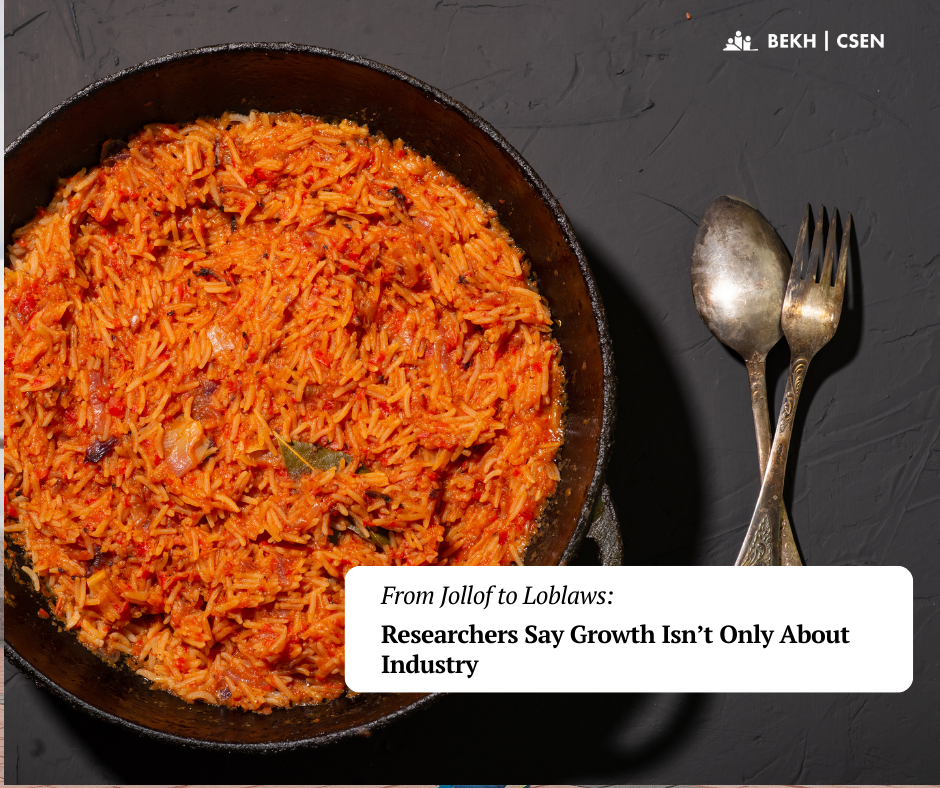
Black entrepreneurs in Atlantic Canada are often concentrated in sectors like food, hair care, and retail, and the reasons why are widely debated. Some observers point to market size, while others cite limited access to high-growth industries. Researchers at the Atlantic Hub of the Black Entrepreneurship Knowledge Hub (BEKH) suggest that the real story is more complex and that it reveals deeper truths about what shapes growth in the ecosystem.
Why Black Entrepreneurs Are Not Entering ‘High-Growth’ Sectors
For many entrepreneurs, the barrier is not lack of ambition but lack of support. Atlantic Hub researchers note that deeper ecosystem challenges prevent more Black founders from moving into technology, manufacturing, and advanced production. Entrepreneurs who might otherwise pursue high-growth fields often turn toward more affordable options because startup costs are prohibitive.
The recently published BEKH study, Factors Impacting Business Choice for Black Entrepreneurs in Atlantic Canada, supports this conclusion. The study notes that low access to financing, racialized perceptions of credibility, and limited mentorship networks make high-growth fields feel inaccessible. It observes that entrepreneurs often “avoid industries requiring high financial outlay” because the pathway into them is unclear or unsupported.
Skills and prior experience also play a role. “If we are going to move into tech sectors, usually you have someone who has the skills to operate in that domain,” noted Dr. Harvi Millar, BEKH Atlantic Hub Lead and Professor of Operations Management at Saint Mary’s University. Entrepreneurs may have the vision, he explained, but often lack access to the technical expertise needed to execute it. Networks, therefore, become essential as pathways into emerging sectors.
The challenge of navigating networks and support systems has also contributed to initiatives like the Black Entrepreneurship Ecosystem Map (BEEM), which aims to make programs, organizations, and opportunities across the ecosystem easier to find.
For Dr. Millar, the question is not about reluctance but access. “People did not go into areas where they did not feel a sense of belonging and that was confirmed,” he said. “If you do not see a whole lot of Black folks in tech, the chances that you may decide to start a tech business are low”.
Some entrepreneurs described situations where their credibility was questioned. One respondent described customers repeatedly assuming they were not the business owner. Others noted feeling “systemically blocked” from certain industries and described difficulty joining local business associations or networks that did not feel inclusive.
These structural barriers explain the limited presence in high-growth industries. But they also highlight something else: they also impact growth in sectors where Black entrepreneurs are concentrated, revealing that the issue is bigger than industry choice.
Turning Cultural Products into Scalable Consumer Goods
While many cultural products and services are often described as low-growth industries, researchers believe these sectors hold significant opportunities if they adopt scalable models. Shakara Russell Joseph, BEKH Atlantic researcher and professor at Dalhousie University, notes that home kitchens, while a cost-effective start-up, limit the ability to expand production.
“We have the entire Sunday dinner as an offering,” she said. She argues for focus rather than breadth. “Perhaps it is understanding which of those dishes are actually the most marketable as a product that has the possibility to expand. And if it is jollof rice, then we should do the most cost effective jollof rice.”
Dr. Millar agrees and emphasizes the appeal of cultural foods to mainstream consumers. “I would love to walk into Sobeys and buy a packet of jollof rice and heat it up,” he said. “The same way we buy Mexican rice or broccoli rice.” He notes that some cultural foods have already gained recognition with mainstream supermarkets and could follow the path of products like Jamaican beef patties, which are now sold nationally.
The same logic applies to beauty and hair care. Joseph points to innovators exploring synthetic hair made from coconut and banana fibers. “The question becomes how do we help them move from retailer of the products into deep manufacturing,” she said. “That is what opens up the markets. You move into a volume game that we are not participating in right now”.
Atlantic Canada as a Testbed for Scalable Models
The researchers argue that Atlantic Canada’s environment may offer a unique advantage. Joseph describes the region as small, interconnected, and responsive.
“Because we are small and very well connected, we have the ability to test things very quickly,” she said. “It does not take a long time for things to activate”.
She notes that large brands already use Atlantic Canada as a market-testing site. “Before Subway launches a product, they launch it in small town Nova Scotia,” she explained. “If it can survive in small town Nova Scotia, it will survive in small towns anywhere”.
Given the region’s diversity within a compact geography, cultural goods can be tested with both Black and non-Black consumers, offering insights that entrepreneurs might not gain as quickly in larger urban markets.
Still, researchers insist that growth in the ecosystem will require environmental shifts. Dr. Millar encourages entrepreneurs to explore shared purchasing, joint production, and collaborative marketing.
“If they have similarities in terms of their supplies and then by being able to lower their cost, they might be able to improve their profitability which could then be reinvested to help them scale”.
He also advocates for a formal Black business association in the region.
“We need a mechanism that is managed and controlled by us,” he said. He envisions an organization that coordinates mentorship, entrepreneurial training, development opportunities, and partnerships across the region.
Dr. Millar and Joseph argue that the characteristics of Atlantic Canada’s ecosystem such as demographic interactions, cultural networks, and historical significance for Black Canadian communities reveal dynamics that can inform national policy and program design.
Dr. Joseph argues that long-term policy commitment must align with these ecosystem efforts.
“If you are running in a four-year cycle, you are actually only doing two years of work,” she said, noting the time it takes for start-up activities and funder reports. “You need a ten-year strategy with funding attached to it”.
Dr. Millar adds that Atlantic Canada also contains a long-established African Nova Scotian community whose history of advocacy has produced policy changes in education and public service. This history, he argues, strengthens the region’s potential to advocate for entrepreneurial supports.
“It can be easier to push for policy changes because African Nova Scotians have a long history here. They are one of the founding groups alongside the Acadians and the Scots, and of course the Indigenous peoples who were already here, since this was their country,” he said, suggesting that similar advocacy could influence entrepreneurship policy and ecosystem funding.
Across their research, Millar and Joseph identify a consistent pattern. Growth is shaped by the environment around the business, not by the sector alone. Whether producing jollof rice, synthetic hair fibers, or technology-driven services, entrepreneurs need networks, capital, pathways, and coordinated policy support. As Joseph puts it, “You cannot tell people to go into high-growth industries if there is no pathway. You do all the work on your side and you get to the door and it is shut.”